
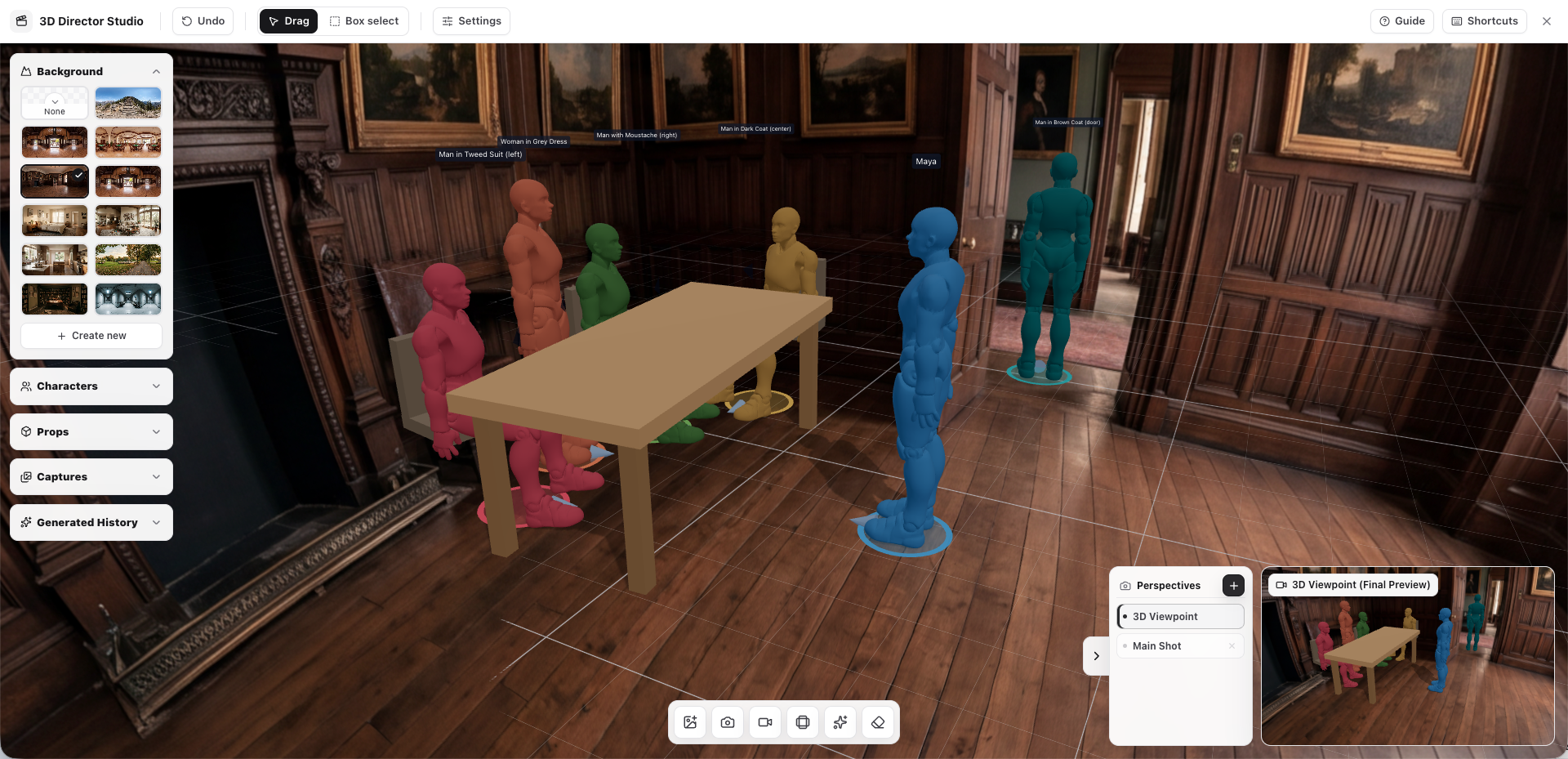
Director Studio: Control AI Video Like a Filmmaker
Learn how Plot Party's Director Studio helps creators control character blocking, poses, props, scenes, and camera movement so AI video models generate closer to your creative intent.
Plot Party MCP turns your AI agent into a director. Connect one URL to Claude, ChatGPT, Cursor, or Codex and generate character sheets, nine-grid variations, Seedance 2.5 and Kling 3.0 clips, dialogue, and music without leaving the chat. Setup, tools, a step-by-step episode workflow, and FAQ.

Most creators now start a project in a chat window. You brainstorm the premise with Claude, outline episodes in ChatGPT, keep the character bible in Cursor next to your scripts. Then, to actually make the video, you leave. You open a generation tool, re-explain the characters, paste prompts one at a time, download clips, and come back.
Plot Party MCP removes the leaving. It is a remote Model Context Protocol (MCP) server at https://plotparty.ai/mcp. Paste that URL into Claude, ChatGPT, Cursor, Codex, or any MCP-compatible agent, sign in once, and the agent you already talk to can generate character sheets, storyboard variations, video clips with Seedance 2.5 or Kling 3.0, dialogue, and music through Plot Party. Your credits and credentials stay on Plot Party's side. The agent does the directing.
This guide covers what changed to make this practical, what Plot Party MCP actually exposes, how to connect each client, a full step-by-step episode workflow, and where the limits are.
MCP has existed since late 2024. Anthropic introduced it, OpenAI adopted it at DevDay in October 2025, and by mid-2026 Claude, ChatGPT, Cursor, Codex, and most agent frameworks speak it. What was missing was an agent reliable enough to run a twelve-step production without losing track.
That gap closed this month. OpenAI's GPT-6 Astra began rolling out on September 3, 2026 with a 1M-token context window and a large jump on agentic-workflow benchmarks. Claude's current models have handled long tool chains for a while. Between them, the agent on the other end of an MCP connection can now hold a full script, a character bible, a style guide, and the history of every asset it has generated, then make the next call correctly.
Higgsfield's Games 2.0 launch on Astra this week is one example of the pattern: a frontier agent plans, a creative platform generates. Plot Party MCP applies the same pattern to the thing we care about, which is stories with a cast that survives from shot one to shot forty.
Plot Party MCP is the same generation backbone that powers the Plot Party canvas, exposed as tools an agent can call. Authentication is OAuth. The agent asks for two scopes, mcp:read and mcp:tools, and every call is logged and billed to your account in credits.
Generation is asynchronous. A video call returns immediately with a card that polls its own status and updates in place when the clip is ready, so the agent is not blocked while Seedance renders a 30-second take.
| Tool | What it does |
|---|---|
generate_image | Story frames, concept art, product visuals, and reference-driven images |
generate_character_views | A multi-angle character sheet from a description or a photo, the identity anchor for every later shot |
generate_nine_grid | Nine controlled variations of one reference image: same subject, style, and setting, varied pose, expression, angle, and framing |
generate_video | Cinematic clips from a prompt plus reference images, with model, duration, aspect ratio, and audio options |
generate_audio / list_supported_audio_voices | Dialogue and narration with model-specific voices |
generate_background_music | Soundtrack for the cut |
upload_media | Send your own images or video into the pipeline as references |
models_explore | Let the agent inspect which image, video, and audio models are available and what parameters each accepts |
get_tool_result | Poll a task and return signed media URLs when it finishes |
fetch_history | Recall earlier generations in the session |
get_account_balance | Check credits before spending them |
The agent chooses per shot, or you tell it which to use.
| Type | Models available through MCP |
|---|---|
| Video | Seedance 2.5 (omni, up to 30-second single take), Seedance 2.0 (omni), Seedance 2.0 Fast, Seedance 2.0 Mini, Kling 3.0 Pro, Kling 3.0 Pro Turbo, Kling 2.5 Pro, Gemini Omni Flash, Happy Horse |
| Image | GPT Image 2 and 2.5, Nano Banana 2, Gemini 3 Pro Image, Seedream v5 |
| Audio | MiniMax Speech 2.6 HD, ElevenLabs multilingual |
Two reference modes matter. The Seedance family, Gemini Omni Flash, and Happy Horse take omni references: pass every image the clip should follow, such as the storyboard frame, the character sheet, a prop, or a previous clip for continuation. Kling models are frame-locked: pass an explicit first frame, and optionally a last frame, when the shot pins exact start and end images. The agent handles this distinction, but knowing it helps you ask for the right shot.
On top of the raw tools, Plot Party exposes skills: complete production playbooks the agent can run from start to finish. The current catalog includes:
The agent lists what you can use, starts a skill, keeps the run's state, and asks you one question when a real decision is needed. Skill workflows are visible to the agent as a definition to follow, so you can also ask it to adapt one: "run the four-grid short drama but make shot three a slow push-in."
Claude (claude.ai or desktop). Open Customize, then Connectors. Choose Add custom connector, name it Plot Party, paste https://plotparty.ai/mcp, and sign in with your Plot Party account when the browser prompt appears. Claude Code and Cowork use the same server.
ChatGPT. ChatGPT supports remote MCP servers only, which Plot Party is. On a paid plan, enable Developer Mode, add a custom connector with the same URL, and authorize. Connector availability can depend on plan, region, and workspace settings.
Cursor and Codex. Add the server URL to the client's MCP configuration. The OAuth flow opens in a browser the first time and the token is stored for the session.
Cherry Studio, OpenClaw, Hermes, and other agents. Same URL, same OAuth. If the client supports remote MCP with OAuth, it works.
The official Plot Party MCP guide has screenshots for each client.
Here is a complete session, as it runs in Claude with the connector live.
Step 1: Set the brief and the budget.
Direct a 60-second vertical microdrama. Premise: a night-shift nurse finds
a letter addressed to her in a patient's coat. Tone: quiet, realistic,
Kore-eda-style. Two characters: the nurse (late 20s, tired, kind) and the
patient (70s, sharp-eyed). Keep both faces consistent in every shot.
Check my balance and estimate cost before generating anything.
The agent calls get_account_balance, lists the skills you can use, and proposes the four-grid short drama with an estimated credit cost. You confirm.
Step 2: Lock the cast.
The agent calls generate_character_views twice, once per character, and shows you the sheets. If the nurse looks too polished, you say "more tired, hair coming loose," and it regenerates only her. These sheets become references for everything downstream.
Step 3: Board the shots.
The skill plans four key shots and generates the keyframe board. For a shot that needs options, the agent calls generate_nine_grid on the nurse's sheet to explore nine expressions and angles and lets you pick the one that lands the beat. Nothing moves to video until you approve the board.
Step 4: Film.
The agent calls generate_video per shot with the character sheets and the approved keyframe attached as omni references. The two-shot dialogue beat goes to Seedance 2.5 as a single 25-second take. The insert shots go to Seedance 2.0 Fast. If a shot needs an exact opening frame, the agent switches to Kling 3.0 Pro with that frame locked. Each call returns a card that updates itself when the render finishes.
Step 5: Sound.
generate_audio produces the patient's last line in a voice the agent picks from list_supported_audio_voices. generate_background_music produces a restrained piano bed.
Step 6: Review, revise, publish.
The agent polls with get_tool_result, assembles the cut, and returns signed URLs. Revision is a sentence: "regenerate shot two with the camera lower and hold on her hands." Everything you made is also in your Plot Party account, so you can open the canvas, trim, subtitle, and publish to the community from there.
Total time is typically under half an hour. You never opened another tab.
Several platforms now expose video models over MCP. The difference is what the tools are shaped like.
| Generic video MCP | Plot Party MCP | |
|---|---|---|
| Unit of work | A prompt becomes a clip | A story becomes characters, boards, shots, and a cut |
| Consistency | Your job: re-describe the character every call | Character sheets and nine-grids are first-class tools and travel as references |
| Planning | None; the agent improvises | Skills give the agent a production playbook with approval gates |
| Long takes | Usually 5 to 15 seconds | Seedance 2.5 single takes up to 30 seconds for dialogue scenes |
| After the chat | Download files | Everything lands in your Plot Party canvas for editing and publishing |
If you want one stunning clip, any video MCP will do. If you want episode three to star the same people as episode one, the tools have to know what a character is.
upload_media, generate a presenter sheet, and film short reference-driven clips with the product locked in frame.models_explore shows what your account can run.https://plotparty.ai/mcp as a connector in Claude, ChatGPT, Cursor, or Codex and authorize.The full setup guide with screenshots is at plotparty.ai/guide/mcp. If you would rather learn the workflow in the app first, our drama episode tutorial walks through the same steps in the canvas, and our guide to the best AI video models of 2026 explains when to pick Seedance over Kling.
A remote Model Context Protocol server at https://plotparty.ai/mcp that lets AI agents such as Claude, ChatGPT, Cursor, and Codex call Plot Party's image, video, audio, character, and skill tools directly from a chat.
Yes. Add the URL as a connector, sign in, and ask the agent to generate. Video runs on Seedance 2.5, Seedance 2.0, Kling 3.0, Gemini Omni Flash, or Happy Horse, billed in Plot Party credits.
No. Setup is pasting a URL and signing in. The agent handles the tool calls. Coding matters only if you are building your own agent or automating a pipeline.
Character sheets from the character views tool and nine-grid variations travel as references into every video call. Skills carry those references automatically from shot to shot.
Seedance 2.5 for dialogue and long single takes up to 30 seconds. Seedance 2.0 Fast or Mini for drafts and coverage. Kling 3.0 Pro when a shot needs an exact locked first or last frame. Ask the agent to run the models tool if you want to see what your plan includes.
Generation is billed in Plot Party credits per task, at the same rates as the canvas. The agent can check your balance before spending. See pricing for plans.
Yes. Cursor, Codex, Cherry Studio, OpenClaw, Hermes, and any MCP client that supports remote servers with OAuth.
Signed URLs come back to the chat, and every asset is also saved to your Plot Party account, where you can open it in the canvas to edit, subtitle, and publish.
Learn how Plot Party's Director Studio helps creators control character blocking, poses, props, scenes, and camera movement so AI video models generate closer to your creative intent.
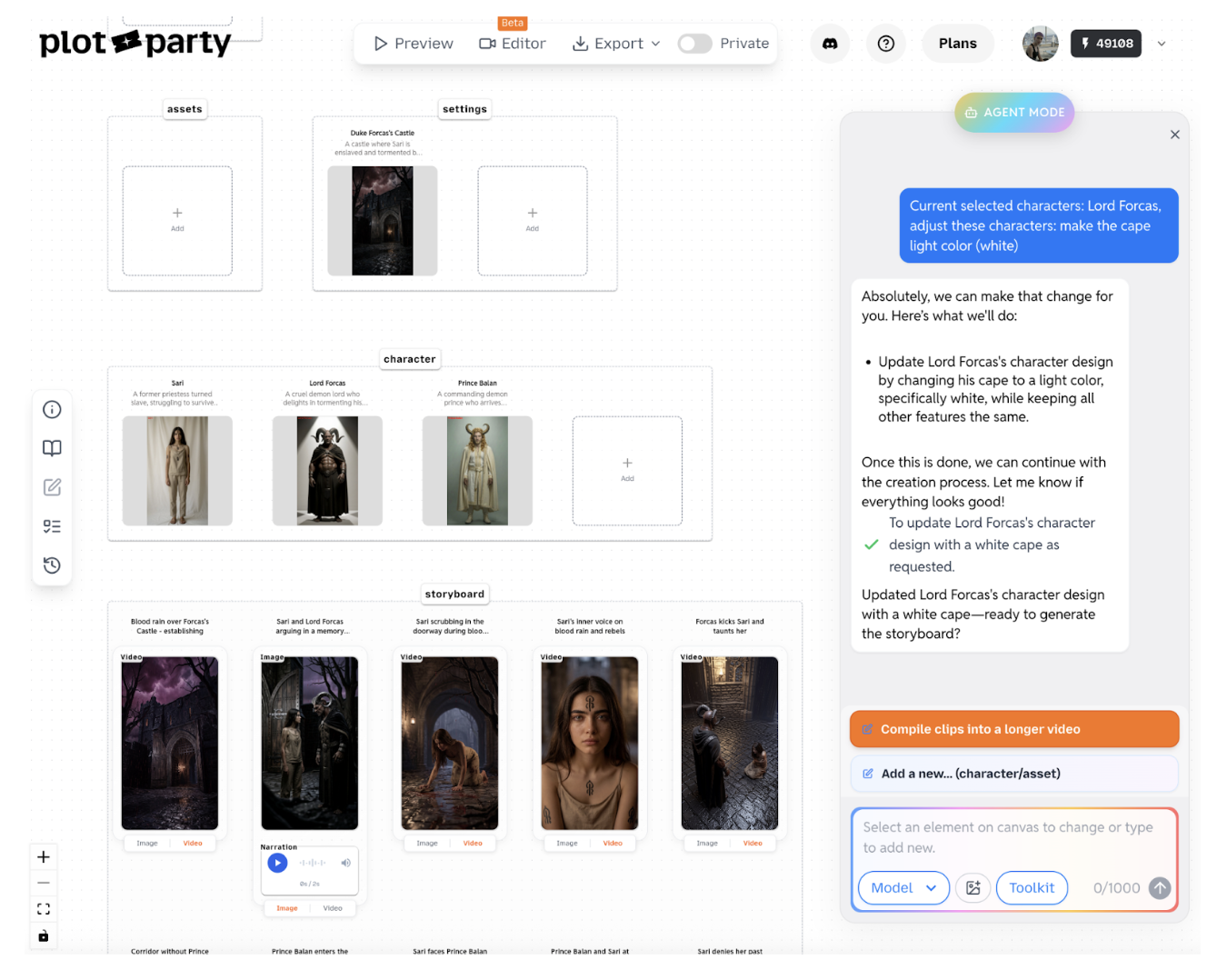
Learn how to create a 1-2 minute AI drama episode on Plot Party. From writing your script to generating videos and publishing — a complete walkthrough of the agentic canvas.

Learn how to create compelling AI-generated microdramas from scratch. Step-by-step guide covering story structure, AI video generation, character design, and publishing your first microdrama on Plot Party.
Turn your ideas into AI-generated microdramas. No filmmaking experience required.